
Classic Favorite Succulent Containers
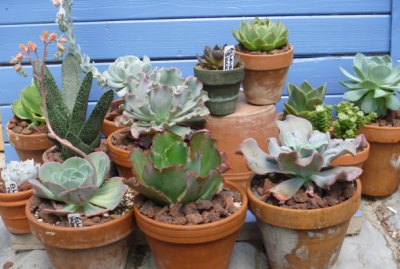
Do you use terracotta and clay pots to display your succulent plants? Find out here why they’re the best choice. They have several advantages over plastic pots.

They are heavier than plastic pots, even when the soil is dry.
This is important as some succulent plants can get very top heavy, and tipping is a real danger. If your plants are grown in plastic pots, just place them inside a clay pot to prevent this, once the plants get too big.
Terracotta pots also drain better, and as most succulents prefer a dry soil which drains fast when watered this is a definite advantage.
Check for a drain hole – I’ve come across several that had none, due to a manufacturing defect. If you’re very careful, you can drill a hole in the bottom with a masonry bit and a high speed drill.

Due to the porous clay, the roots and soil can dry out faster, and there is also more oxygen exchanged – a good thing for succulents and cacti.
They also look nicer, I think. The orangy tan colour complements the subtle greys, blues and soft tones of many succulent plants.
What Size of Terracotta Clay Pot do I need?
Choose a terracotta pot for individual plants based on the size of the plant. Don’t over pot, using a bigger pot than what the plant needs right now. Find out why you should pick the right size of pot for each stage of your succulents growth.
Over potting will just lead to root rot as the soil will not dry out, which is so necessary for good succulent plant growth.
A pot that’s too small, on the other hand, will mean that you have to repot again very soon, and it may not be heavy enough to prevent the plant from tipping over.

How to Care for Terracotta Clay Pots
Terra cotta pots can’t take any frost as they’re made from low fired clay – for winter storage, they must be emptied of soil and plants, dried off, and put into a preferably frost free place, such as a basement.
Mexican strawberry pots are a common type of container popular for succulent plant gardeners made out of this type of clay.
If they are completely dry, they will be fine outside or in a dry greenhouse or other storage area for the winter.
Wash or brush any debris out of them prior to storage.
New or Used?
New terracotta pots are popular enough nowadays that you can find them in garden centers in most areas.
Make sure you soak the pot in water before planting, to wash off dust and contaminants.
I find used terracotta pots in recycle center, thrift shops or garage sales; as romantic as they seem to be initially, most people find they don’t perform well for many other plants such as annuals and anything that prefers moist situations.
The preference for droughty conditions makes succulent plants a prime candidate for planting in clay pots.
You can tell if an empty terracotta or clay pot is sound (not cracked) by tapping on it with a fingernail.
A sound pot will have a ringing sound; if you hear a dull thud, there’s a good chance that it has a crack forming. I’ve had some large pots with a crack that went for a long time still in use, but you may not want to use any that have cracks or faults.
Don’t Discard any Cracked Pots!
However, if you have any terracotta or clay pots that have cracks, don’t discard them!
Do what I do and make funky and rustic garden art such as plant labels out of them.
Use an industrial felt pen or paint to write plant names. I rely on Sharpie felt pens, which last for several years before fading.
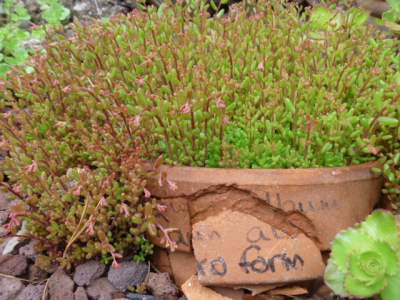
They also make a great edging for an herb garden, or broken into very small shards can perform as mulch around lavender, rosemary or other drought tolerant plants.
Use caution, as these shards can be sharp, so place them with care (and gloves).
I’ve also come across some other great ideas for using these common but rather delicate planters; even broken, they can be stuck together in innovative ways, and planted with moss, small succulents and ferns to make a fairy garden, with steps, tiny furniture and maybe a metal butterfly or other little feature.
Laid down on their broken side, they become a house for a toad; or many together on a piece of rebar stuck in the ground make a tower to plant with trailing Sedum. The uses for them are endless.
If you can’t bear to discard anything, this is a way to keep those precious objects close to you.