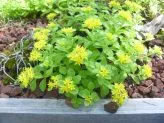
The Hardy and Versatile Stonecrop
Sedum is one of the most well known genera of plants in cottage gardens, xeriscape gardens and commercial landscaping, with good reason.

Also called stonecrop or orpine, their reputation as an unflappable hardy perennial plant is well deserved, as they will thrive in some of the most challenging conditions we can throw at them.
Due to the botanists getting carried away and being unable to decide where exactly each type of plant fits, it also goes by the Latin name of Hylotelephium, generally in reference to the plants we know as Sedum spectabile and telephium.
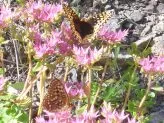
Gardeners aren’t the only ones to appreciate all that Sedum have to offer – butterflies and pollinators are very attracted to the nectar and pollen.
Interesting common names; this is an indication of just how long these plants have been grown and loved in our gardens;
Other odd names that this plant gets called are bittercress, welcome-home-husband-be-thee-ever-so-drunk, and live forever.
Biting Stonecrop, Prick Madam, Wall Ginger, Mousetail, Bird’s Bread, Jack-of-the-Buttery, Golden Carpet, Gold Chain, Small Houseleek, Mossy Stonecrop, & Creeping Tom are also common names in various places to describe Sedum acre.
Sedum sarmentosum is known as Stringy or Trailing Stonecrop, because of the way it grows and Yellow Moss, Star Sedum or Gold Moss.

I plant lots of their favorite plants for butterfly food to attract them to the butterfly garden – the Sedum is a hands down winner in July and August as it comes into full bloom.
Origins of Sedum
Sedum can be found almost around the globe, wherever tough conditions are.
Even North America boasts several native Sedum species; Sedum lanceolatum, S. integrifolium, which is also called S. roseum, and S. stenopetalum. Sedum spathufolium and S. divergens are also native to high alpine and rocky outcroppings.

Many lovely Sedum varieties and species have been tested in Europe on green roofs, and you can’t get much more difficult conditions than that.
Green roof Sedum varieties are the most willing to face drought, thin soil and harsh environments.
These are native to the high mountains and wild places across Europe, including the Balkan Mountains and the Carpathians.
As with many other favorite garden plants, interbreeding and hybridizing has produced many superior forms with longer bloom time, stronger growth habit and different colors than the species.
Gardeners through the years across many continents have used these classic plants in sunny mixed borders alongside other drought tolerant plants, along pathways and in rock gardens – then stood back to let them strut their stuff.
Well behaved and slow spreading they seldom wear out their welcome. If they do, they’re easy to remove or prune to keep within bounds.
They are used with great success as a backbone plant for containers, troughs and Sedum tapestry beds where they fill in among other plants and trail over the edges to soften the planting.
The species and varieties native to Europe and North America are in most cases hardy to around Zone 3, depending on winter conditions.
Full sun exposure and great drainage are key to their success.

Sedum Facts
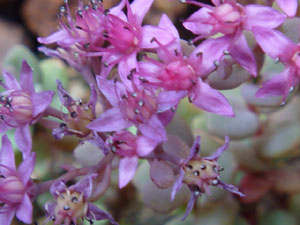
Many Sedum are deciduous, losing all or most of their leaves in the fall.
Some that fall into this category are Sedum spurium ‘Dragons Blood’ and Sedum cyaneum ‘Rose Carpet’ as well as one of my all time favorites, the exquisite Sedum pluricaule.
Others are evergreen, retaining the same leaves year after year such as most of the Sedum reflexum varieties such as ‘Angelina’ and ‘Blue Spruce’, as well as Sedum sexangulare and forsterianum.
Most of the Sedum for borders such as ’Sedum spectabile ‘Autumn Joy and Sedum telephium ‘Purple Emperor’ are typically left standing after dormancy into the winter as the seed heads are an interesting structure in the colder months.

They provide winter interest, attract birds and also capture snow and prevent it from blowing away.
Sedum for groundcovers reliably fill in gaps between taller plants, on slopes and banks for soil conservation and for non-stop seasonal interest, with textural differences, foliage and bloom colour throughout the summer and fall.
How to Grow Sedum
Sedum – along with most other types of plants with succulent foliage – have the ability to survive long periods without irrigation or rainfall.
Growing Sedum in a xeric garden forms the backbone for groups of other types of plants which tend to go dormant under stress, to give a presence and structure to the garden even during extended droughts.

Winter conditions are the most critical for Sedum – if high rainfall is followed by freezing temperatures many Sedum will succumb, turning into black mush.
The best way to combat this threat is to provide extremely good drainage so no water ever puddles at the crown of the plant. Even if the leaves and smaller twigs die back, the crown of the plant will live to sprout again.
Ideal conditions for Sedum are those found in raised beds where you can customize the drainage, particularly in clay soils.
Adding a small amount of steer manure and a higher proportion of grit or gravel when building the bed will provide the perfect situation.
Pruning Sedum
The deciduous types will benefit from a haircut in the spring to remove the dead twigs and boost new growth from around the crown.
Sedum for groundcovers tend to get a bald spot around the crown without pruning to encourage the new vigorous growth. It’s important to prune the dead stalks off before new growth starts to emerge so you don’t damage the tender sprouts.
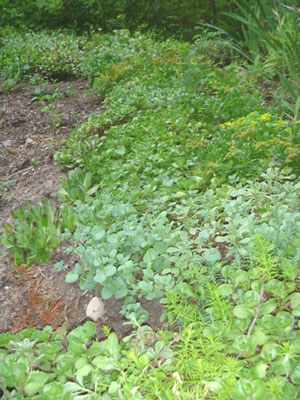
I have used a weed whacker to take the dead flower heads off creeping Sedum in the late summer, which shapes them nicely to start fresh in the spring.
The border Sedum require cutting with shears or pruners in the spring on a case by case basis, as the stems are too tough for this cavalier treatment.
Fertilizing Sedum
It’s not necessary to fertilize, as Sedum, along with many of their relatives prefer a lean soil.
Over fertilizing will lead to floppy weak growth and aphid infestations, as well as making them less able to withstand drought.
A small amount of worm castings around the base of the plant, or a sprinkling of a weak solution of compost tea once a season will be perfectly adequate.
Mulching
Mulch with river rock or lava rock to prevent soil erosion and provide a tiny amount of micro nutrients as the mulch weathers.
Avoid using organic mulches such as wood chips or bark, as they can retain too much moisture around the crown of the plant.
With so many types and varieties of Sedum to choose from, you’ll enjoy using these versatile and hardy plants to give your xeriscape garden a buffer against drought.
Find out more about Sedum below…
Each link will take you to another page by other visitors…

Wood stem, pink on the leaves.
I’m not sure what this is, it’s starting to die and I’m not sure if it needs to be watered daily or weekly. The stem is almost like twig. It’s the one …
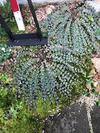
This plant is 1-2 feet in diameter, with long stems radiating from the center. Groups of three leaves cling to the stem at about 1″ intervals. The leaves …

I bought this succulent along with many others, and was curious about what its name was.. Thanks for your help!!
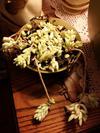
Small oval shaped grows on long stem sometimes white, sometimes green, climbs
I purchased this at a yard sale for only $3.00 but just love it but the tiny pieces fall off, although they don’t die, they seem to root but would like …

looks kinda like a dwarf Burros Tail, very small
Cant for the life of me figure this one out, looks small, dwarf I would call it. The heads are as big as a dime. Pretty easy to grow.

A common succulent that contains a lot of water in its stem and fat, stubby leaves.
A common succulent that contains a lot of water in its stem and fat, stubby leaves.
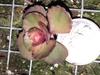
unidenitfied pinkish leafy succlent plant
About the size of a quater, pinkish tinted leaves. growing zone 6, growing it indoors. its a succulent drought resistant plant. not sure of the name of …
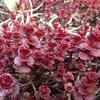
tiny flowery type succulent. a bit viny. maroon colored ground cover. Hi Katie, this is one of my favorite plants, and my stock in trade – Sedum, or …

This plant has over the last few weeks has spread along our roof guttering, and seems to be rooting in the gutter moss. The plant is probably very …

Unknown Vancouver Sedum
Unknown Vancouver Sedum Drought Smart Plants reply: This is some type of Sedum spathufolium, which is a native to British Columbia and other areas …

Pink and yellow succulent found in Idaho mountains
picture attached. This plant was found in the mountains of Idaho above Riggins. Drought Smart Plants reply: Congratulations! You’ve found one of …

Legacy Succulent
Small chunky very old succulent passed from my grandmother (and possibly my great grandmother)to my father and now to me. Goes red when the flowers …

Unknown plant
I just want to know what it is – was a gift and nobody can tell me what it is help me please. Drought Smart Plants reply: Hi Mary, you don’t say …

Tennessee Wildflower
I have found four or five of these most unusual plants on our property, growing wild on a creek bank in Tennessee. They appear to be succulents, …
reminds me of a cat tail
It’s green and has these thorn looking leaves sprouting upwards and it curls like a cats tail, do you know what it is? Drought Smart Plants reply: …