

by Ken Steinberg
(Toronto, Ontario)
Wow! what a great, informative site! I’m a teacher and we’ve successfully propagated some succulents.
How do we (prune?)train them to create the hearty, low-to-the-ground rosette shape?
Thanks in advance!
Gr 7, MJDS
Drought Smart Plants reply:
Hi Ken, welcome to you and your students – start ’em young, I always say! Gardeners are made, not born, so your kids will have a head start on this fascinating hobby/lifestyle.
To answer your question, it would help to know what exactly the plants were. Pruning will certainly make them break new growth from buds below the cut, but if they aren’t a rosette forming plant to start with, no amount of training will make them adopt that type of growth habit.
To get the rosette shape, you need to start with plants that have that type of shape to start with: some of my favorite low growing hardy succulents are Sempervivum and Jovibarba. These are similar to some of the tender types such as Echeveria and its relatives, but are super hardy in cold climates. These will come back bigger and better every year, eventually making a colony or cluster.
If some of what you have is Sedum, the low growing types such as Sedum spurium varieties will benefit from an annual trim – I use a weed whacker for this if I have a large area to cut back, and this promotes new growth from the stems that are left. Sometimes, these types of plants tend to grow outward from a central crown, leaving it balding and bare. The pruning will help keep them compact and bushy.
Best of luck with your project,
Jacki
See these pages too:
Comments for School Succulent Project
Oct 22, 2011
RE: School Project
by: Ken
Wow, everyone needs to spread the word about this site, your knowledge and responsiveness! Your a gem!
Ok, so from your site, I believe our plants are sedum and as I’ll call them the ‘super’vivum. The parent plants are definitely rosette forming plants.
This photo on your site is what we’re aiming for:

‘Super’vivum Stock Plants
The new growth, from dispatched leaves, is healthy and vigorous but is growing upwards on stems. I imagine we need to pinch this. How low do we go?! How is this done to get the rosettes, like your photo, close to the ground?
With our sincere gratitude,
Ken & Grade 7 MJDS
Oct 22, 2011
Nature, not Nurture
by: Jacki
Hi Ken, thanks for your great comments (blushing)
The plants in the photo are Sempervivum, and their normal growth habit is rosette forming, unless they start to bloom which is pretty obvious as the whole plant starts to elongate, or ‘cone’.
Once this happens, it’s game over for the plant, as they are what is known as ‘monocarpic’ or ‘once flowering’.
The plants growth habit can’t be changed by pruning it or any other cultural factors.
I’m not 100% sure that this is what you have from your description, but without a picture I can’t ID them. Can you post a picture on this page: Succulent Plant Identification? – just start a new post.
Oct 26, 2011
RE: School Project
by: Ken
Very intriguing, Jacki! What you say is perfectly clear and makes total sense. I’m baffled, because I was almost the parent plants were part of a mixed planter with single, low and full rosettes, like this beautiful arrangement on your site:
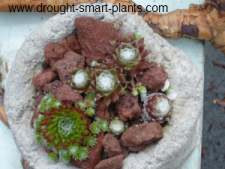
We’ll keep on goin’ and growin’!
KS