Unique Tender Succulents –
Add some Panache to your Succulent Containers
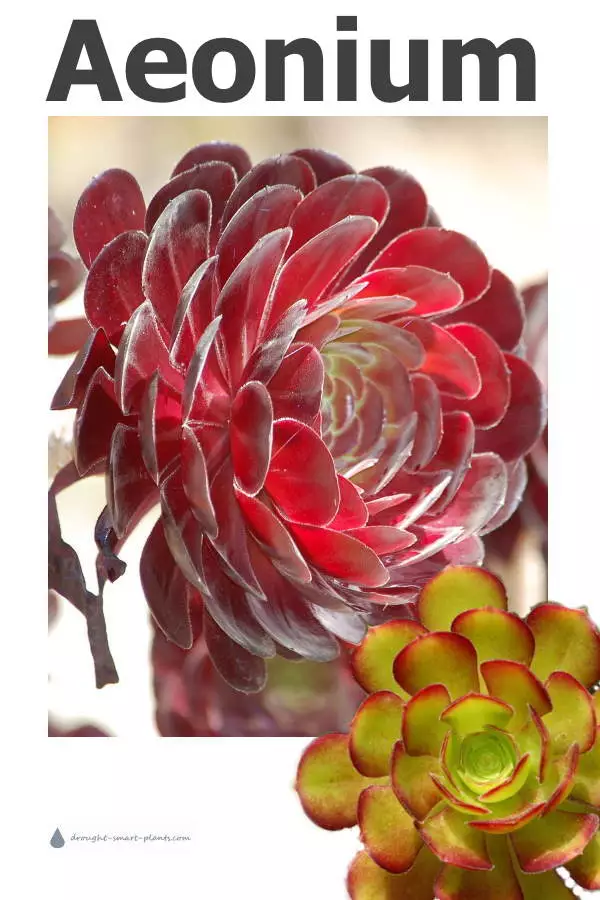
If you have a plant that looks a little like an Echeveria, but with thinner leaves and long stems, you may have an Aeonium.
Aeonium are without a doubt, some of the most beautiful and sought after additions to succulent collections.
They reward our efforts with gorgeous spoon shaped foliage in shades of burgundy and green, sometimes variegated with splashes of palest gold.
Aeonium are native to the Canary Islands and North Africa, so you may be able to guess their preferred conditions – warm, or even hot would be the key word.
The name means ‘evergreen’ so this is a plant that never loses its leaves – until after it blooms that is, when the flowering rosette dies.
Climates that are similar to their native lands such as in California these incredible plants can give some formidable impact to the landscaping.
See the plant that Colleen found when she moved to her new home in San Jose. The flower spike alone is over 2 meters tall.
The pink, red, yellow or white flowers form from the middle of the rosette in spring or summer, after which the rosette will die. Hopefully, you will have propagated some rosettes to take its place.
Find out more about these intriguing plants here.
Quick Facts About Aeonium;
Aeonium doesn’t have a common name. They originate in the Canary Islands and Tenerife, where they have adapted to the intense heat of late summer by going dormant. This is sometimes a surprise for those that aren’t familiar with the genus, as most other succulents rely more on day length rather than heat to trigger a dormancy.
The leaves of most Aeonium are spoon shaped, and thin, although this isn’t always the case. Some are more spear shaped.
There are many different kinds, with one common trait. Each rosette is monocarpic, which means ‘once flowering’. The rosette (usually the oldest one) will start to elongate, and a fluffy bloom stalk emerges. Once the flower dies, so does the rosette. With luck, the mother will have produced lots of pups around the base of the stem. These can be pulled off to make more plants.
Aeonium ‘Velour’
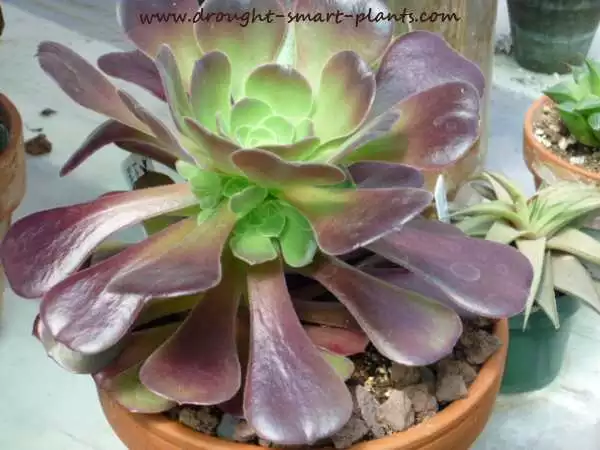
Some Aeonium will form a fairly tall stand of rosettes of green, dark burgundy or variegated foliage each on the top of a slender stalk. The leaves are spoon-shaped, sometimes glossy, and occasionally matte.
They can reach a height of a meter (3′), or less than 15cm (5″), depending on the variety. Other species and varieties are suitable for mixed planters and succulent crafts as they tend to be more compact.
Easy to propagate, just remove a rosette with a piece of stem and allow to callous overnight and the stem end can be planted into a pot.
So what’s the twist? Aeonium are not like other succulent plants.
They go into a summer dormancy when it gets hot in the late summer, and stay that way until the weather cools off in the fall, when they start to grow again.
While they’re dormant, water them enough to keep them alive. And don’t worry – they’re not dying.
How to Grow Aeonium
Aeonium grow best where minimum temperatures are about 4 degrees Celsius; they can’t take any frost, so a sheltered or indoors environment only for this plant. It requires good ventilation, and bright light – full sun is fine, or partial shade.
Aeonium prefer a little more moisture in the soil than many other succulent plants. Water as soon as the soil is dry, but don’t allow it to dry too much.
Gear the watering to the temperature; the cooler the weather, the less you need to water. Use tempered or lukewarm water to avoid shocking the roots.
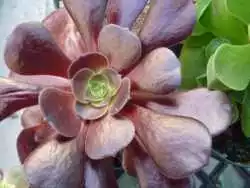
Aeonium arboretum ‘Velour’
The lovely velvety texture and rich colour of Aeonium arboretum ‘Velour’ is very recognizable. The sheen of the foliage appears to be in ‘soft focus’.
The botanical term ‘arboretum’ refers to a tree like form, so this plant will get quite big. Luckily, beheading the rosettes to grow new plants will encourage more buds to break lower down, making it bushier.
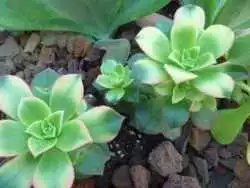
Aeonium haworthia ‘Kiwi’
Soft shades of pale banana, strawberry and lime make this plant a mouthwatering tropical treat. Unhappy in full sun where it tends to sunburn it prefers shade in the afternoon but still bright light.
Smaller in stature than the two purple varieties shown here, it will form a short clump rather than the tree like form of the others. The same conditions of soil and water apply.
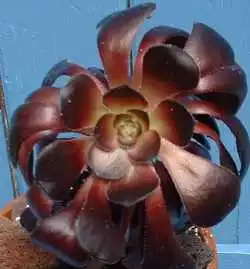
Aeonium ‘Schwartzkopf’
This is the one everyone thinks of as typical of the genus as it’s one of the oldest cultivars.
Rightfully popular, even after all this time with its glossy foliage and bossy attitude.
Regular beheading will keep Aeonium ‘Schwartzkopf’ in bounds and give you a supply of new plants to replace the aging rosette when it blooms.
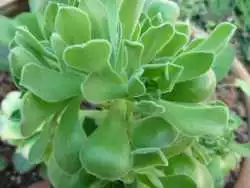
Aeonium green species, thought to be A. balsamifera, due to the sticky coating on the leaves. Somewhat unpleasant to touch, but interesting.
See what other satisfied Aeonium owners have said
find out more about Aeonium below…
Do you know the name of this species?
Hello! I just got back from my vacation in Spain. There was a beautiful plant in my rented apartment. The leaves look like flowers to me, and it is very …
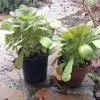
Possible Aeonium?
I took 2 cuttings from my sister’s plant in Burbank, CA. In just a few months, they grew to about a foot tall in pots. Her plant in planted in the …
Is this Echeveria?
This was given to me as a gift and I’m not sure how to care for it! It appears healthy but the long stems have the pot looking bare. Once I know what it …
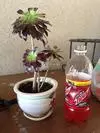
He looks kinda like the trees from “The Lorax”…
…and that’s the main reason I bought him! I picked this little guy up today at a little shop out in the country, here in the Central Valley of California. …
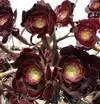
Need help identifying this plant
My friend has this beautiful succulent. She says she has it in this color and green. Can somebody please tell me what plant this is? Many thanks. Mala …
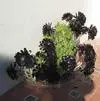
Black fleshy leaves
My wife saw this at Hearst Castle in California and loved it. I’d like to purchase one for her. Hi Scott, good choice! This is one of my favorite …

Rosette about 5 inches diameter. Thin waxy leaves with serrated, dark red edges. Leaf backs are almost entirely reddish-purple..
I got this “mother” Echeveria from a friend as a stalk cutting. Each winter it forms a ring of offshoots around the stalk just under the main rosette that …
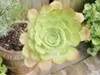
I assume this is an Echeveria…. Pls help me get more specific.
I took this shot outside a nice restaurant that we went to, and I think it is common, but I can’t find out what it is with any certainty. Any help would …
Thin long palm, succulent plant on top
Thin long palm succulent plant on top consisting of rounded leaves with pointed tips, look like a rosette, lots of baby ones at base of plant. Drought
green cabbage center and maroon outside leaves
green cabbage center and maroon outside leaves Drought Smart Plants reply: Hi Sherry, you have one of my all time favorite plants – this is one …
I’m not sure if this is Echeveria
But I figured you could at least tell me more about what this could be. I picked this up at a flower shop here in Houston, Tx over the weekend because …
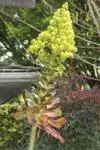
What is this plant in our new home?
Large green rosettes with rounded burgundy edges. Large (18″) yellow flower spike. Over 7′ tall. How does it propagate? Drought Smart Plants reply: …
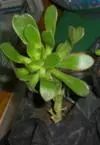
Floral arrangement of leaves
I guess this is a common plant. Yet, our tourist-resort-owner had said, it just won’t survive the plains … fingers crossed. Drought Smart Plants …
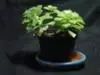
3 Succulent Cuttings
Forms a small branching plant, was about 12inches high we had an accident with the original but I now have 3 cuttings which are doing fine. Each about …
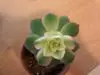
Randomly Bought Plant
I bought a plant from the local market and it has fat dark green leaves. The newer leaves are a shade of light green. On the outside edges of the leaves, …
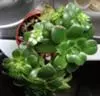
Unidentified Succulent
I bought this succulent yesterday. The green leaves grow in clusters. The stem had several roots reaching down from the stem into the soil. It is 5″ tall. …

large green succulents
These grow in somewhere Carmel Highlands. They are giant solitary yellow-green succulents with shallow bowl shaped appearance and almost no stalk. I …
An Irish Bouquet?
Hi! I just brought home a new succulent that is labeled “Irish Bouquet” by the company that sold it, but I can’t find any other information about it anywhere …